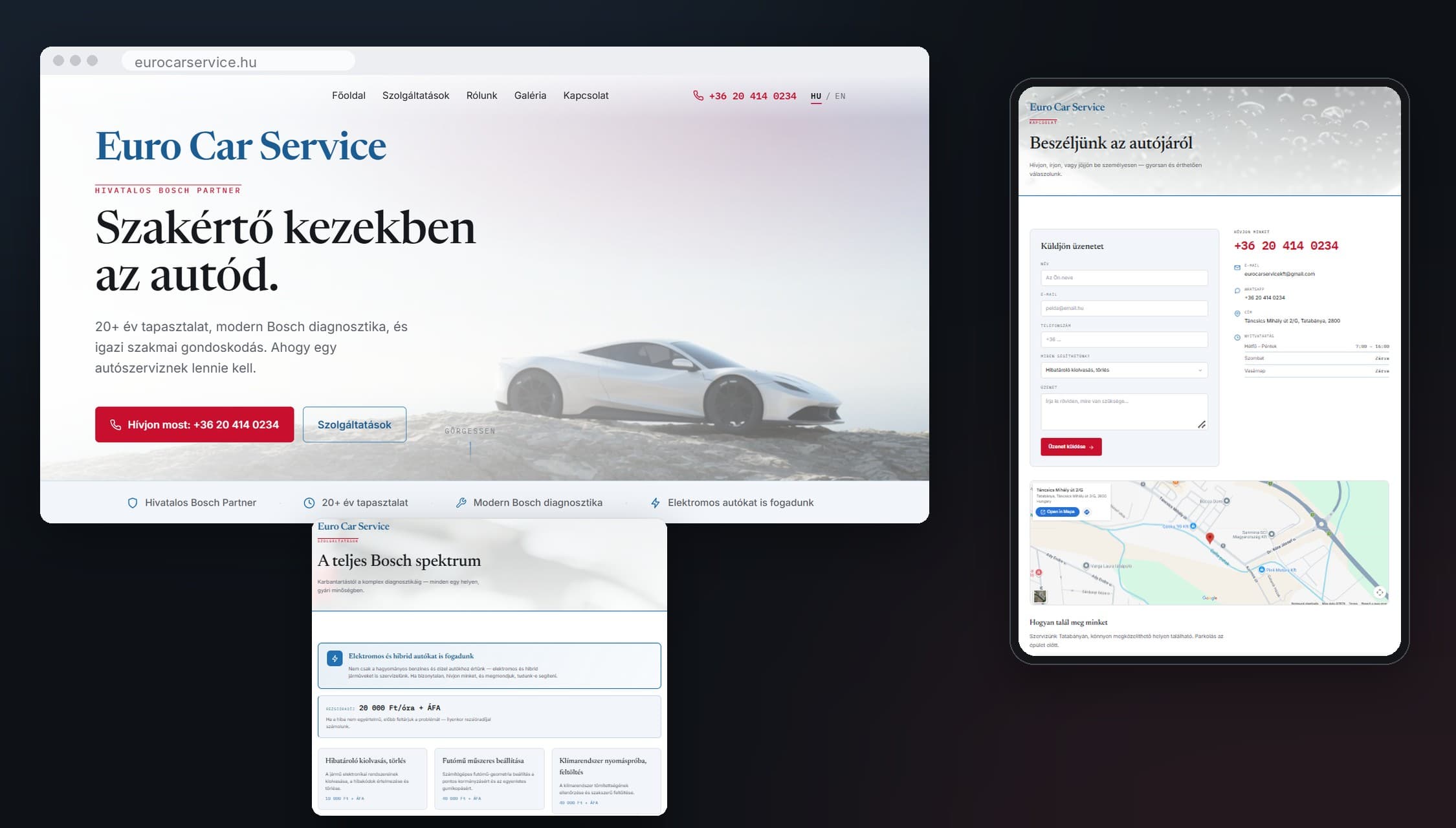
The brief
EURO CAR SERVICE is a Bosch partner car workshop in Tatabánya, Hungary. The team needed a new website that works well on a phone, speaks both Hungarian and English, and that they can update themselves without calling a developer.
Most visitors of a local workshop arrive from a phone, usually to do one of three things: call, send a message or find the address. So the site had to make those three things the easiest actions on every page.
What I built
A completely new site, designed and built from scratch, with these pages:
Because the visitors are mostly on phones, the site is designed for phones first.
- The phone number can be called with one tap, on every page.
- A quick bar at the bottom of the screen on mobile: Call, Message, Map.
- Fast loading and a clean, modern look.
- A HU / EN switch in the header.
Content management
The team edits the site in Sanity Studio. They sign in with the company's Google account, change the text and press Publish. The change is live within a few minutes. No programming knowledge is needed.
They can edit:
- Company details: phone, e-mail, address, WhatsApp, opening hours and social links.
- The home page headline and introduction.
- Services: names, descriptions and prices. New services can be added.
- The hourly rate, the About page, reviews, gallery photos and background images.
Every text field has a Hungarian and an English version. If the English one is left empty, the site shows the Hungarian text instead of a blank.
How it works
The site is a Next.js app hosted on Netlify. Its content lives in Sanity, which is why a published edit reaches the live site within minutes. The contact form posts to the site's own API endpoint, which sends the e-mail with Nodemailer. Analytics starts only after the visitor accepts cookies.
Privacy and security
A workshop's site collects very little, but what it does collect has to be handled properly. These were the decisions.
- The contact form does not use an outside service. It runs on the site's own endpoint, so visitors' messages never pass through a third party. It has built-in protection against automatic spam, and its service list is read from the same content the team edits.
- Analytics needs consent. Google Analytics 4 measures page views, device type and a rough region, but only if the visitor accepts cookies. The cookie bar offers “Accept” and “Only the necessary”, and the choice can be changed at any time from the footer.
- Real legal texts. The privacy policy and cookie policy use the company's real details. I recommended that a legal expert reviews them before launch.
- The client owns everything. Source code, hosting and content management are all under the company's own accounts, and I advised changing the passwords once the project was closed.
For search engines, every page has its own title and description in both languages, structured company information (auto repair business, address, phone, opening hours), a sitemap, a robots file, a share preview image for Facebook, Messenger and WhatsApp, and correct language markup.
Handover
I wrote a handover document for the team, in Hungarian: what was built, how to edit each part of the site, how search and analytics work, how the contact form works, the technical background, the accounts, and a step-by-step guide to uploading photos to the gallery.
I also wrote a Facebook marketing guide for them: how the algorithm works, how often and when to post, four content pillars, tone, links and hashtags, and a simple monthly plan.
What is next
At handover the site was finished. What was left was on the client's side: uploading real photos of the team and the workshop.
- Real photos: the team photo for the About page and gallery photos of the workshop and the work.
- Google Business Profile: fill it in and add the website, the most effective step for local search.
- Legal review: have an expert read the privacy texts.